Índex, Contemporary Art Magazine (ISSN: 2477-9199) is a biannual publication dedicated to research, critical analysis, and reflection on the visual arts. Its purpose is to foster thought and debate from a perspective rooted in Latin America, addressing the complexity of the contemporary art field through a dialogue with diverse disciplines and contexts.
Targeting academic and artistic communities as well as the general public interested in deepening their understanding of artistic practices and discourses, Índex is published in both electronic and web formats. It aims to establish itself as a reference platform for the study and dissemination of art at the local and regional levels.
The magazine organizes its content around thematic axes including: art and education, art history and criticism, reviews of publications and exhibitions, art collecting and market, art and new media, aesthetic thought, visual studies, and visual essays.
With an approach that combines rigorous research and openness to new perspectives, Índex seeks to contribute to the dialogue on contemporary art by strengthening the exchange of ideas and experiences among creators, researchers, and specialized audiences.
Current Issue
Vol. 10 No. 20 (2025): Index No. 20
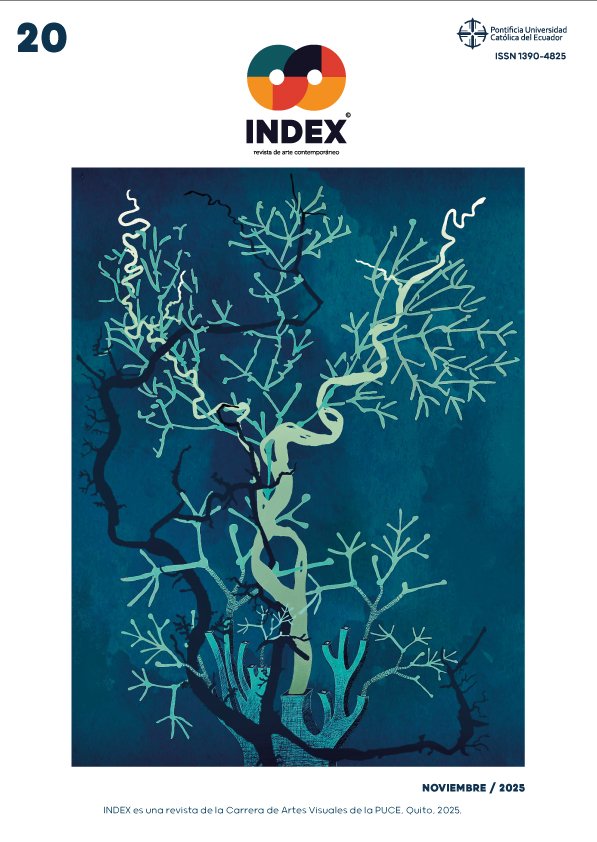
This 20th issue of ÍNDEX Arte Contemporáneo features on its cover the work of Fernando Falconí, whose cyanotype series Cartografías para un árbol de agua —both cover image and visual essay of the issue— transforms old maps of rivers such as the Guayas or the Amazon into trees and vegetal patterns, in order to question the relationship between science, techné, landscape, and memory. In the Art Themes section, Tiffany Garzo offers a reading of My Dinner with André through the lens of biopolitics and societies of control; Belén León-Río explores the energy of matter as a force of consciousness within creative processes; María Fernanda Gallardo reflects on walking art as a device to subvert hegemonic imaginaries of the Andes and their cartographies; and Federico Del Giorgio Solfa critically reviews contemporary debates on research in design. The issue closes with the Curatorial section, featuring a text by Giada Lusardi on Estiaje, an exhibition by Juana Córdova, Irina Liliana García, and Pamela Suasti, where collaborative practices and organic materials activate a poetics of waiting, ecological fragility, and care.
Published: 2025-12-10